Byline: Sujan Pariyar, Senior Editor
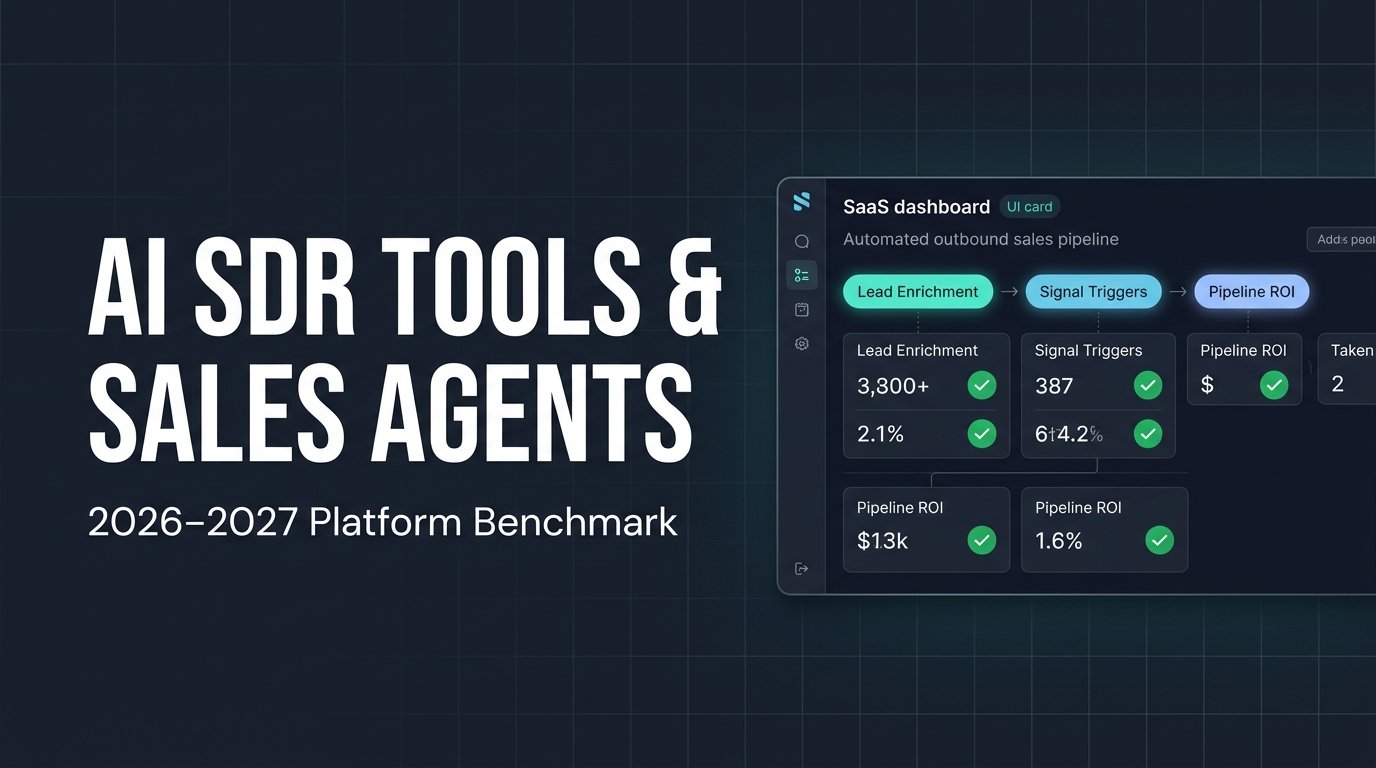
Best AI SDR Tools & Autonomous Sales Agents in 2026–2027: 9 Platforms Tested for Real Pipeline ROI
Outbound B2B sales has undergone a structural reset. For years, scaling pipeline meant hiring cohorts of junior Sales Development Representatives to manually scrape LinkedIn profiles, enrich contact lists, and send semi-personalized email sequences. That playbook broke down as inbox spam filters tightened, domain reputation rules hardened, and buyer fatigue reached an all-time high.
Over the past eighteen months, a wave of autonomous AI SDR platforms promised to replace manual prospecting entirely. Built on multi-agent reasoning models, these tools claim to research target accounts, monitor real-time buying signals, write hyper-personalized emails, and book qualified meetings on your calendar without human intervention. Yet as we highlighted in our recent Gartner and McKinsey 2027 AI Spending ROI Report, deploying autonomous agents without strict guardrails frequently leads to runaway token costs and disappointing bottom-line returns.
To separate genuine revenue engines from expensive spam cannons, we evaluated nine leading AI SDR and autonomous outbound platforms across data enrichment accuracy, email deliverability protection, CRM integration depth, and transparent pricing for 2027.
Quick Comparison: Top AI SDR & Outbound Platforms (2026–2027)
| Platform Name | Core Approach | Primary Channels | Starting Price | Best For |
|---|---|---|---|---|
| Artisan (Ava) | End-to-end autonomous AI SDR | Email & LinkedIn | ~$1,500+/mo (Annual contracts) | Mid-market teams wanting a hands-off digital worker |
| 11x (Alice) | Enterprise digital worker for outbound | Email, LinkedIn & Phone | ~$5,000/mo (Enterprise tiers) | Large revenue organizations with complex enterprise ICPs |
| AiSDR | Signal-based autonomous prospecting | Email & LinkedIn | ~$750–$900/mo | Fast-moving startups needing quick setup and flexible billing |
| Regie.ai | AI-native sales engagement & co-pilot | Email, Social & Call scripts | ~$35,000/yr (Team plans) | Enterprise sales teams augmenting human SDRs with AI |
| Apollo.io (AI) | All-in-one B2B database + AI sequences | Email, Dialer & LinkedIn | Free / ~$49–$119/user/mo | Bootstrapped founders and SMBs wanting consolidated data |
| Clay | Programmable AI data enrichment & workflows | Multi-tool API orchestration | ~$149–$800/mo | Growth engineers and RevOps teams building custom agents |
| Reply.io (Jason AI) | Multi-channel AI SDR assistant | Email, LinkedIn & WhatsApp | ~$300–$500/mo | Agencies and SMBs managing multi-channel outreach |
| Relevance AI | Custom no-code B2B agent builder | Custom API & CRM triggers | ~$199–$599/mo | Technical teams building proprietary outbound agents |
| Unify | Warm intent-to-outbound automation | Email & Ad retargeting | ~$1,000+/mo | SaaS companies converting website visitors into pipeline |
How We Evaluated These AI SDR Platforms
Evaluating an AI SDR requires looking far beyond how well the software writes a cold email. In 2026, almost any large language model can draft a passable outreach message. The real differentiators—and the reasons many teams cancel their contracts within six months—come down to four operational pillars.
First, we examined data hygiene and waterfall enrichment. An autonomous agent is only as reliable as its underlying contact database. Platforms that rely on a single static data provider routinely generate bounce rates above 5 percent, which quickly destroys domain reputation. Second, we tested deliverability infrastructure, checking whether the tool automatically manages secondary sending domains, inbox warm-up, and sending volume throttling. Third, we looked at signal depth, separating tools that simply scrape basic LinkedIn job titles from agents that detect real buying triggers like funding rounds, leadership changes, tech-stack shifts, and job postings. Finally, we scrutinized pricing structure and contract lock-in, noting which vendors force steep annual commitments versus predictable usage tiers.
1. Artisan (Ava) — Best End-to-End Autonomous AI SDR for Mid-Market Teams
Artisan has become one of the most recognizable names in autonomous outbound through its flagship AI BDR, Ava. Rather than acting as a passive software dashboard that requires constant manual prompting, Ava operates as a structured digital worker that handles ICP discovery, lead enrichment, multi-step email drafting, and LinkedIn outreach inside a single workspace.
What stands out about Artisan is its built-in deliverability architecture. The platform automates mailbox warm-up, monitors domain health, and dynamically adjusts personalization angles based on prospect engagement. Its B2B database covers hundreds of millions of contacts alongside local intent signals, reducing the need to stitch together separate subscriptions for Apollo, ZeroBounce, and Instantly.
The main limitation is cost and contract rigidity. Artisan requires custom annual agreements that typically start around $1,500 to $2,000 per month, making it a heavy commitment for early-stage startups still validating their ideal customer profile. Additionally, while Ava handles initial replies well, complex technical objections still require fast human handoff to prevent awkward AI hallucinations.
2. 11x (Alice) — Best Enterprise Digital Worker for High-Volume Outbound
11x targets enterprise revenue organizations looking to deploy full-scale digital workers rather than basic sales productivity plugins. Its outbound agent, Alice, continuously scans the web for real-time account triggers, maps buying committees across target enterprises, and executes coordinated outreach across email and LinkedIn.
Alice excels at deep account research. Instead of inserting generic firmographic variables into a rigid template, the agent synthesizes recent earnings calls, press releases, and hiring trends to construct tailored messaging angles for each stakeholder inside an account. For large organizations running multi-region outbound campaigns, 11x provides granular governance controls and enterprise CRM synchronization with Salesforce and HubSpot.
The primary barrier is enterprise pricing and onboarding overhead. With contracts frequently starting near $5,000 per month and requiring multi-quarter commitments, 11x is built for established sales organizations with proven unit economics rather than lean startup teams.
3. AiSDR — Best Flexible Autonomous Agent for Startups and Lean Growth Teams
AiSDR bridges the gap between heavyweight enterprise digital workers and manual email sequencers. Designed specifically for fast-moving startups and B2B agencies, the platform focuses on converting real-time social and intent signals into hyper-relevant outreach without locking buyers into massive annual contracts.
What sets AiSDR apart is its responsiveness to live behavioral triggers. Users can configure the agent to monitor prospects who engage with specific LinkedIn posts, change roles, or hire for key engineering positions, then automatically launch tailored sequences referencing that exact event. Unlike rigid legacy tools, AiSDR also handles basic inbox objection handling and calendar booking natively.
On the downside, teams running massive enterprise territories may find its account-mapping depth lighter than 11x or Clay. Pricing starts around $750 to $900 per month based on lead and email volume, offering a much lower barrier to entry than enterprise competitors.
4. Regie.ai — Best Hybrid AI Platform for Enterprise SDR Teams
While pure-play autonomous agents aim to replace human reps, Regie.ai takes an AI-native sales engagement approach that blends autonomous prospecting with human rep execution. Built for mid-market and enterprise sales floors, Regie unifies prospect data, content generation, dynamic sequencing, and rep task prioritization into one platform.
Regie’s standout strength is brand governance and multi-channel coordination. Its AI agents handle repetitive top-of-funnel tasks—such as researching accounts, drafting personalized emails, and warming up cold leads—before surfacing warm, high-intent prospects to human SDRs for live phone calls and social selling. Enterprise RevOps leaders favor Regie because it prevents rogue AI messaging from damaging brand reputation.
Pricing is geared toward established teams, typically starting around $35,000 per year for bundled platform and agent seats, making it less suitable for solo founders.
5. Apollo.io — Best All-in-One Database and AI Outbound Suite for SMBs
For startups and small businesses that cannot justify spending $1,500+ per month on a dedicated autonomous agent, Apollo.io remains the most practical all-in-one outbound engine on the market. Over the past year, Apollo has embedded autonomous AI research and sequence-writing agents directly on top of its massive B2B contact database.
The biggest advantage is workflow consolidation and price transparency. Teams can filter leads, verify email addresses, run AI-generated personalization prompts across thousands of prospects, and execute multi-step email and dialer sequences from a single login.
The trade-off is automation depth. Apollo’s AI features act primarily as intelligent co-pilots rather than truly autonomous workers that monitor live web signals or manage inbox replies independently. Paid plans range from $49 to $119 per user per month, making it unmatched for cost efficiency.
6. Clay — Best Programmable AI Workflow Engine for RevOps and Growth Teams
Clay is not a plug-and-play AI SDR out of the box—it is the programmable data and AI orchestration backbone powering the best outbound teams in B2B tech. Instead of relying on a single vendor’s database, Clay lets growth engineers chain together more than 75 data providers using waterfall enrichment alongside custom AI research agents.
With Clay’s AI agent (Claygent), teams can automate hyper-specific research tasks at scale—such as visiting every prospect’s website to check if they offer a specific integration, analyzing their pricing page, or summarizing their latest product changelog—before feeding those insights into Instantly, Smartlead, or HubSpot. Just as we noted in our Complete 2026 AI Timeline when tracking how fast model tiers like Gemini Flash reshaped high-volume workflows, Clay allows teams to route routine enrichment tasks through low-cost models while reserving flagship reasoning models for complex account synthesis.
The limitation is learning curve. Clay requires dedicated RevOps or growth engineering expertise to build and maintain workflows. Plans start around $149 per month for basic credits and scale to $800+ per month for high-volume teams.
7. Reply.io (Jason AI) — Best Multi-Channel AI SDR for Agencies and SMBs
Reply.io evolved from a traditional cold email sequencer into an autonomous outreach platform through Jason AI, its built-in AI SDR assistant. Jason AI helps small teams define their target audience, source verified B2B contacts, build multi-channel sequences across email, LinkedIn, and WhatsApp, and manage initial prospect responses.
Jason AI is particularly attractive for B2B lead-generation agencies and small sales teams that need multi-channel reach without enterprise complexity. Its reply-handling mode can either draft responses for human approval or operate on autopilot to book meetings directly onto a rep’s calendar.
Pricing starts around $300 to $500 per month depending on active contact volume and mailbox limits, placing it comfortably between budget sequencers and high-ticket digital workers.
8. Relevance AI — Best No-Code Platform for Building Custom Sales Agents
For technical founders and operations teams that refuse to be boxed into off-the-shelf SDR templates, Relevance AI provides a visual platform to build, train, and deploy custom B2B multi-agent teams. Instead of buying one generalized AI SDR, companies can assemble specialized agents—one for inbound lead qualification, another for deep account research, and a third for CRM hygiene.
Relevance AI shines when your sales motion relies on proprietary internal product data or complex qualification rules that standard AI SDRs cannot handle. Teams can connect custom APIs, internal knowledge bases, and Slack approval loops directly into the agent’s workflow.
Because it is an agent-building platform rather than a turnkey database, you still need to bring your own contact data and sending infrastructure. Plans start around $199 per month and scale with compute and action volume.
9. Unify — Best Intent-Driven Outbound Platform for SaaS Companies
Unify approaches AI outbound from a warm-intent perspective rather than pure cold prospecting. The platform captures de-anonymized website visitors, product-usage signals, and third-party intent data, then triggers automated AI research and personalized outbound sequences the moment a target account shows buying behavior.
By focusing on accounts already researching your category, Unify consistently generates higher reply and conversion rates than cold list-blasting tools. It bridges the gap between marketing attribution and SDR execution, ensuring high-intent traffic never slips through the cracks.
Pricing typically starts above $1,000 per month, making it best suited for B2B SaaS companies with steady inbound website traffic to convert.
Honorable Mentions: Emerging AI Outbound Challengers to Watch
Alongside the nine platforms above, several specialized tools are gaining rapid momentum among technical sales teams heading into 2027:
Valley: A LinkedIn-first AI outbound platform built specifically to automate high-trust social selling, profile engagement, and warm connection sequences without triggering platform restrictions.
Amplemarket (Duo): An all-in-one AI sales platform combining a deep B2B database, deliverability tools, and an AI copilot that surfaces daily high-priority signals for human reps.
Lindy AI: A flexible no-code AI assistant platform widely used by startup founders to build lightweight, custom email triage and outbound prospecting agents connected directly to Gmail and HubSpot.
(Editorial Note: We update our B2B software benchmarks regularly as autonomous agent capabilities and pricing models evolve. Building an AI SDR, sales agent, or revenue intelligence platform and want your 2027 product updates tested for our next revision? Send product specs and sandbox access to our editorial desk via our Contact page.)
4 Critical Mistakes That Cause AI SDR Rollouts to Fail
In our analysis of AI Predictions for 2027, we highlighted Gartner’s forecast that more than 40 percent of agentic AI projects will be canceled by the end of next year due to unclear business value and inadequate risk controls. Outbound sales is one of the fastest places to see this failure pattern if teams skip basic operational discipline.
Blasting High Volume Without Secondary Sending Domains
Never connect an autonomous AI SDR directly to your primary corporate email domain. Even well-tuned AI agents generate lower reply rates than warm referrals. Always isolate outbound traffic across dedicated secondary domains with properly configured SPF, DKIM, and DMARC records, capping daily volume at 30 to 50 emails per inbox.
Automating Broken Positioning
An AI SDR acts as an amplifier. If your value proposition is vague or your ideal customer profile is poorly defined, an autonomous agent will simply burn through your total addressable market ten times faster. Validate your messaging manually with 200 to 300 prospects before handing the playbook to an autonomous worker.
Ignoring Post-Click Brand Visibility in AI Search
Modern B2B buyers rarely book a demo immediately after reading a cold email. Instead, they open ChatGPT, Perplexity, or Google to research your product and compare you against competitors. As we detailed in our benchmark of the Best AI Visibility & GEO Tools in 2026–2027, if AI search engines fail to mention your brand or cite outdated reviews when prospects look you up, your outbound conversion rates will collapse regardless of how personalized your emails are.
Signing Long-Term Contracts Without Reply-Quality Benchmarks
Avoid locking into twelve-month contracts based solely on live sales demos. Require a structured 60-day pilot with clear exit criteria tied to positive reply rate, bounce rate under 2 percent, and actual sales-qualified opportunities created—not vanity metrics like emails sent.
Frequently Asked Questions
What is an AI SDR tool?
An AI SDR (Sales Development Representative) tool is an autonomous software agent that automates top-of-funnel B2B sales tasks, including prospect discovery, contact data enrichment, buying-signal monitoring, personalized email and LinkedIn outreach, and initial reply handling.
Can AI SDRs completely replace human sales reps in 2027?
No. While autonomous AI SDRs excel at high-volume account research, signal monitoring, and initial cold outreach, human reps remain essential for complex enterprise discovery calls, multi-threaded deal navigation, and high-trust relationship building. Most high-performing teams use AI agents to handle top-of-funnel prospecting while human reps focus on closing qualified opportunities.
How much do AI SDR platforms cost?
Pricing varies widely based on autonomy level. All-in-one databases with AI assistants like Apollo.io start around $49 to $119 per user per month, mid-market autonomous agents like AiSDR and Reply.io range from $300 to $900 per month, and enterprise digital workers like Artisan and 11x typically cost between $1,500 and $5,000+ per month.
Do AI SDR tools hurt email deliverability?
They can if misconfigured. Sending thousands of generic AI-generated emails from a single primary domain will quickly trigger spam filters. Leading platforms mitigate this risk by automating inbox warm-up, rotating across multiple secondary domains, throttling daily send limits, and verifying email addresses prior to outreach.

Sujan Pariyar is an international writer. He frequently writes about tech, AI, business, and travel on Silicon Valley Times, NYWeekly, Washington Magazine, Huffpost, Thrive Global and more.




Be First to Comment