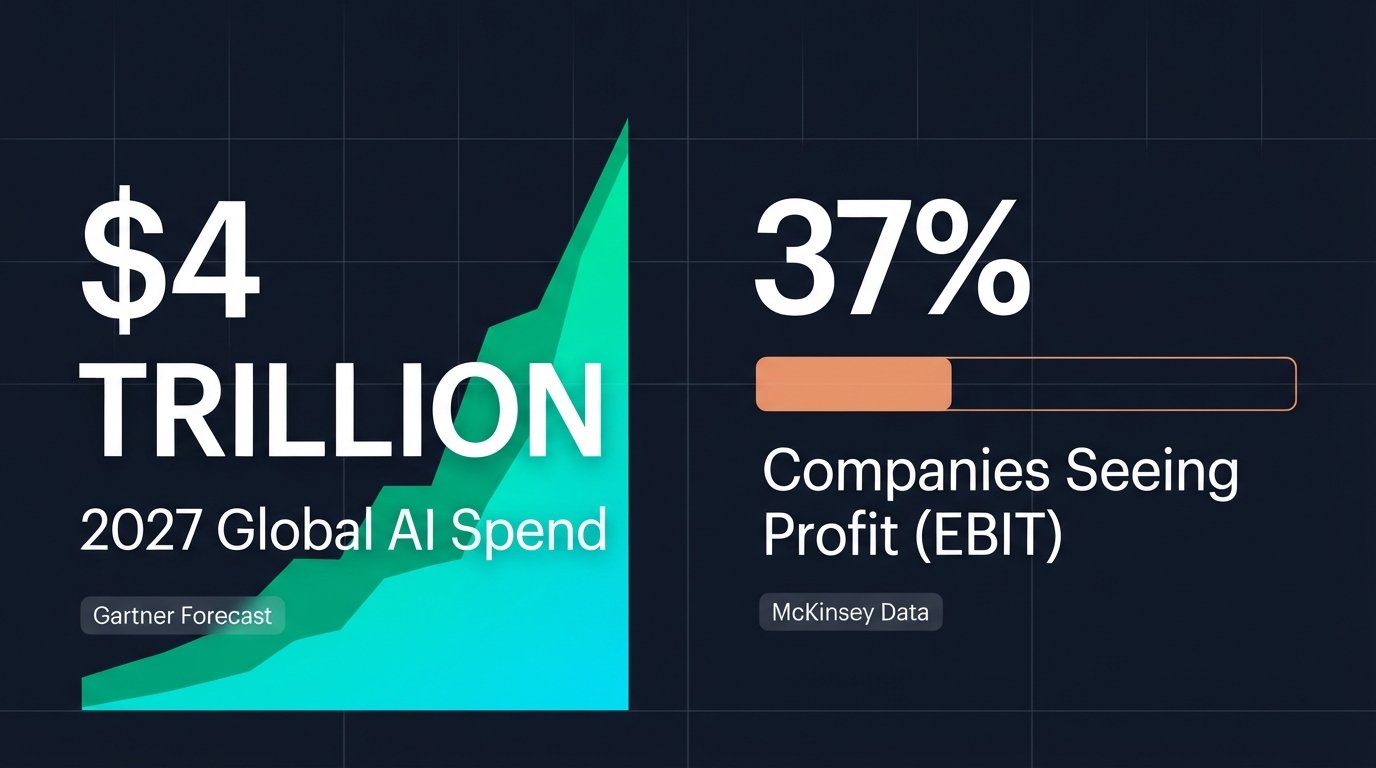
Global enterprise AI budgets are expanding at an unprecedented pace, yet bottom-line financial returns remain stuck in neutral.
On November 12, 2026, Gartner released a new market forecast projecting total global AI spending to reach $4 trillion in 2027, up 47.5 percent from 2026. Within that figure, spending on AI agents and assistants is projected to more than double from $30 billion to $67 billion next year.
Yet McKinsey’s latest State of AI 2026 survey exposes a stark financial disconnect. While 80 percent of employees report that AI boosts personal productivity and 40 percent of large enterprises are actively scaling AI agents, only 37 percent of organizations report any measurable impact on company profit (EBIT)—a figure that has barely budged over the past twelve months.
For founders, CTOs, and finance leaders locking in Q1 2027 budgets, the message from the data is unmistakable. Companies are pouring historic capital into autonomous tools without fixing the underlying cost and workflow traps that prevent those tools from generating profit.
The 2027 AI Spend vs. Profit Disconnect
When read side by side, Gartner’s spending projections and McKinsey’s adoption metrics reveal a widening gap between software deployment and financial return.
| Metric | Source & Date | The 2026–2027 Data | What It Signals for Businesses |
|---|---|---|---|
| Total Global AI Spend | Gartner (Nov 2026) | $4 Trillion in 2027 (+47.5% YoY) | Infrastructure and software budgets are expanding rapidly across every sector. |
| AI Agent & Assistant Spend | Gartner (Nov 2026) | $67 Billion in 2027 (up from $30B) | Autonomous agents are the fastest-growing software category in the enterprise. |
| Bottom-Line Profit (EBIT) | McKinsey (Late 2026) | Only 37% see EBIT gains | 63% of organizations still fail to translate AI usage into net financial return. |
| Token Cost Overruns | Gartner (Oct 2026) | 50%+ over budget on variable pricing | Uncapped multi-step agent loops routinely blow past initial software estimates. |
| Agent Project Cancellations | Gartner Forecast | Over 40% canceled by end of 2027 | Poor governance and unclear ROI are killing nearly half of current agent pilots. |
Why 63% of Companies Are Missing the ROI Mark
The gap between $4 trillion in spending and flat corporate profit comes down to three structural traps that emerged across enterprise deployments in 2026.
1. The “Token Bloat” and Usage-Billing Trap
In 2024 and 2025, most companies budgeted for AI using predictable, flat per-seat SaaS subscriptions. Throughout mid-to-late 2026, major vendors shifted aggressively toward consumption and credit-based models—a structural shift we tracked in our Complete 2026 AI Timeline when platforms like GitHub Copilot moved to usage-based AI Credits billing.
Autonomous agents multiply this cost problem. Unlike a standard chatbot prompt, a single agentic workflow can trigger dozens of background reasoning steps, tool calls, and self-correction loops. In an October 26, 2026 infrastructure report, Gartner warned that enterprises deploying AI agents under uncapped, variable token pricing will exceed their initial cost expectations by more than 50 percent through 2027. McKinsey’s data confirms that token bills are already biting: 1 in 5 organizations (20 percent) report that operating and token costs are actively constraining their AI usage.
2. Individual Productivity Does Not Equal Enterprise Profit
McKinsey’s survey highlights a classic operational bottleneck. Four out of five workers say AI helps them write emails, summarize notes, or draft code faster. However, saving an employee 30 minutes a day rarely shows up on a quarterly earnings report unless the company redesigns the broader business process around it.
Without workflow redesign, individual speed gains get absorbed by existing approval bottlenecks, manual data handoffs, and legacy software silos. Companies end up paying for expensive enterprise AI licenses on top of existing headcount and SaaS overhead without reducing unit costs or accelerating revenue.
3. Scaling Unbounded Pilots Too Early
As we noted in our breakdown of AI Predictions for 2027, Gartner projects that more than 40 percent of current agentic AI projects will be canceled by the end of next year.
The primary culprits are unclear business value, escalating inference bills, and inadequate risk controls. Many teams attempted to deploy broad, multi-department autonomous agents before establishing basic guardrails, human-in-the-loop checkpoints, or clear financial success metrics.
How to Audit Your AI Stack Before Q1 2027
To avoid landing in the 63 percent of companies seeing zero EBIT return, technical and operational leaders need to shift from open-ended experimentation to strict unit-economics discipline.
- Enforce a “No Telemetry, No Deployment” Rule: Gartner specifically advises IT leaders to ban production rollouts of AI agents that lack real-time token tracking, step-level cost attribution, and automated spend caps. Never sign an uncapped consumption contract without hard circuit breakers.
- Route Routine Tasks to Small, Specialized Models: Stop routing every internal workflow through expensive flagship reasoning models. Reserve top-tier models for complex synthesis, and route high-volume extraction, classification, and formatting tasks to fast, low-cost tiers like Gemini 3.5 Flash or Claude Sonnet/Haiku.
- Tie Every Pilot to One Hard Financial Metric: Ban “productivity” as a primary KPI for 2027 AI budgets. Require every new deployment to target a measurable P&L outcome—such as support ticket deflection cost, customer acquisition cost reduction, or shortened billing cycles—and kill pilots that miss their benchmark at 60 days.
- Redesign the Workflow, Not Just the Prompt: Identify where human handoffs slow down your highest-volume operations. Focus agentic automation on eliminating complete steps in a pipeline rather than simply giving employees a faster chat sidebar.
Frequently Asked Questions
How much will companies spend on AI in 2027?
According to Gartner’s November 2026 forecast, total global AI spending will reach $4 trillion in 2027, marking a 47.5 percent increase over 2026. Infrastructure accounts for 59 percent of that total, while spending on AI agents and assistants is projected to hit $67 billion.
Why aren’t more companies seeing profit from AI?
McKinsey’s State of AI 2026 survey shows that while 80 percent of workers see personal productivity gains, only 37 percent of organizations report measurable EBIT impact. Most firms fail to redesign underlying business workflows and get hit by escalating token and usage costs when scaling AI agents.
How much do AI agent projects typically go over budget?
Gartner warns that enterprises deploying AI agents under uncapped, variable token pricing models will exceed their initial cost projections by more than 50 percent through 2027 due to multi-step reasoning loops and unmonitored API calls.







Be First to Comment