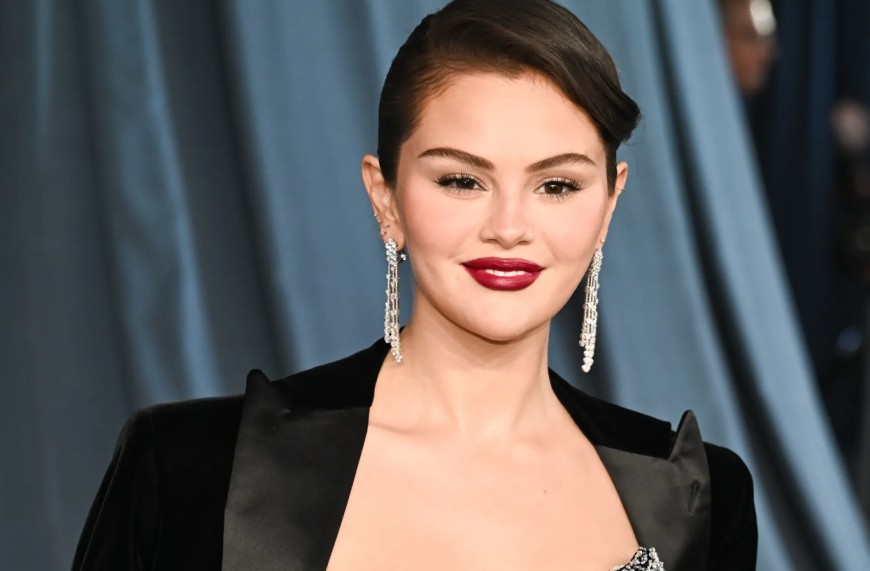
There is a moment from the 2024 TIME100 Summit that tells you more about Rare Beauty than any financial projection or press release. Selena Gomez, sitting on stage in New York City, was asked why she entered the beauty industry. Her answer was disarmingly direct: “I didn’t want to really enter the cosmetics world without a mission.” Then she added, of the Rare Impact Fund — the mental health initiative baked into every Rare Beauty sale — that it is “probably the most important thing I’ve ever done.”
She did not say “the most important business decision.” She said the most important thing.
That distinction matters. It is also, depending on your level of cynicism, either the most authentic thing a celebrity brand founder has ever said in a public forum — or the most effective piece of brand positioning in the modern beauty industry’s history.
Rare Beauty was launched in September 2020 with a $2.7 billion valuation by 2025, revenue that climbed from roughly $350 million in 2023 to more than half a billion dollars in 2024, and the Soft Pinch Liquid Blush that passed three million units sold in a single year, generating about $70 million — and accounting for more than a quarter of Sephora’s entire blush category. It broke Ulta Beauty’s all-time record for launch-day sales when it expanded to all 1,500-plus Ulta locations in February 2026. According to Bloomberg, approximately 81% of Selena Gomez’s estimated $1.3 billion net worth derives from her stake in Rare Beauty.
Every single one of those units sold contributed 1% of its revenue to the Rare Impact Fund — a nonprofit on a mission to mobilize $100 million for youth mental health services globally. As of 2025, the fund has raised over $20 million, supporting approximately 30 organizations across five continents.
The numbers are real. The mission is real. The question that won’t go away is whether the two can coexist in a $2.7 billion commercial enterprise without one eventually consuming the other — and whether building a beauty empire on the language of mental health vulnerability is a genuinely transformative act or the most sophisticated emotional marketing strategy the industry has ever seen.
The Architecture of Authenticity
To understand Rare Beauty’s model, you have to understand what makes it structurally different from every other celebrity beauty brand that has attached itself to a cause.
The 1% donation to the Rare Impact Fund was not added after the brand achieved success. It was built into the financial model on launch day. One percent of all sales — not profits, but gross sales — flows to the fund regardless of the brand’s profitability in a given quarter. That distinction is significant. Most corporate social responsibility programs are funded from profits, which means they disappear during difficult financial periods. Rare Beauty’s commitment survives regardless. It’s not a side initiative — it’s baked into the business, as the brand’s CMO Katie Welch has stated publicly.
The mental wellness integration extends far beyond a financial line item. Rare Beauty integrates mental wellness into its mission in every direction: shade names like Worthy, Empathy, and Grateful remind buyers of positive intentions each time they use the products. Regular social posts highlight coping strategies, helplines, and expert advice for anxiety and depression. Packaging includes affirmations and gentle reminders to practice kindness. Community prompts encourage followers to share stories about what makes them feel rare. Campaign imagery features older models, people with disabilities, and users of every background.
The brand’s foundation range launched with 48 shades. In May 2026, the “True to Myself” campaign paired each of those 48 shades with 48 people sourced across Latin America, directed by Chicana-Costa Rican filmmaker Brittany Bravo — a structural commitment to representation that went beyond casting decisions into how the campaign itself was produced.
What makes this approach commercially effective is something the Rare Beauty CMO’s observation captures precisely: Gen Z consumers, who drive the majority of Rare Beauty’s sales, rank mental health as their top concern in survey after survey, and they can tell the difference between a brand that talks about mental health in its ads and a brand built by a founder who has been hospitalized for hers.
That last phrase is the key. Selena Gomez did not discover the business case for mental health advocacy and then construct a personal narrative around it. She lived the narrative first — and built the brand from it.
The Founder’s Credibility: Lived Experience as Brand Infrastructure
What separates Gomez’s mental health positioning from every competitor attempting to replicate it is the biographical weight behind it. Her openness about her mental health struggles, including a bipolar disorder diagnosis, anxiety, depression, a kidney transplant due to lupus, and multiple hospitalizations, is not recent. It predates Rare Beauty by years and has been shared in contexts — documentary films, vulnerable social media posts, raw televised interviews — where there was nothing to sell.
Her lupus-related arthritis in her fingers directly influenced the brand’s accessible packaging design. “We somehow inherently made the products easy to open and then we realized, wait, they kind of have to be that way,” she shared on the “Good Hang with Amy Poehler” podcast in 2025. “And then we started to make every product with the intention of [working for] anybody who has dexterity problems.” That design philosophy was not a focus-group discovery. It was a personal medical reality translated into product architecture.
The Rare Impact Fund stems directly from Gomez’s advocacy and experiences with her mental health — specifically, the difficulty she faced finding mental health support when she was younger. “I created the Rare Impact Fund with the goal of increasing access to mental health services and education for young people, which is something I wish I had when I was younger,” she said in 2023.
The Rare Beauty Fund represents something the celebrity beauty space has not previously produced: a charitable commitment that is genuinely personal, structurally embedded, commercially self-sustaining, and independently verifiable. The Rare Impact Fund raised $7 million in 2023 alone. Sephora committed to donating 100% of all Rare Beauty product sales on World Mental Health Day for three consecutive years — 2023, 2024, and 2025 — across 25 to 27 global markets. These are not token gestures.
The Dark Side the Title Promises: What the Critics Have Noticed
But the criticism is real, and it deserves honest engagement rather than dismissal.
The first and most structurally significant concern is the percentage itself. 1% of sales is, on one reading, a meaningful structural commitment made at launch. On another reading, it means that for every $38 foundation Rare Beauty sells, $0.38 goes to mental health services — while Selena Gomez’s personal stake in a $2.7 billion valuation compounds. At $500 million in annual revenue, 1% generates $5 million annually for the fund. That is real money for the organizations receiving it. It is also 1% of a business whose founder holds a majority stake worth hundreds of millions of dollars.
The question critics are raising is not whether $20 million over five years for youth mental health services is better than nothing. Of course it is. The question is whether framing a purchase as an act of mental health solidarity, when 99% of the transaction goes into the commercial enterprise, risks turning mental health into a sales mechanism — using vulnerability as a conversion tool in a way that benefits the brand more than the cause.
When a customer buys Rare Beauty blush, the brand’s own literature describes her as “joining a movement.” That framing is powerful and emotionally resonant. It is also, at the transaction level, primarily a purchase of cosmetics. The gap between the emotional weight of “joining a mental health movement” and the commercial reality of “$0.38 per unit donated” is a gap the brand has never publicly addressed.
The second criticism emerged in November 2023, when pro-Palestinian social media users called for a boycott of Rare Beauty after screenshots surfaced showing CEO Scott Friedman following pro-Israel accounts on Instagram. Rare Beauty responded by announcing donations to both Magen David Adom in Israel and the Palestinian Red Crescent Society in Gaza through the International Red Cross — a diplomatic response that satisfied some users and frustrated others who felt it avoided taking a clear position. The incident revealed how a brand built on emotional connection and community trust becomes vulnerable when the politics of its leadership enter the conversation.
The third tension is more subtle but arguably more structurally important. The beauty industry, as a category, generates revenue from the gap between how consumers look and how they could look with product assistance. Rare Beauty’s messaging urges self-acceptance and challenges unrealistic standards of perfection — while simultaneously selling the tools of cosmetic enhancement. The brand acknowledges this tension more honestly than most, but it does not resolve it. A lipstick called “Worthy” and a blush called “Empathy” are genuinely thoughtful naming decisions. They are also still lipstick and blush, priced at $20 to $40, sold in a category that has historically profited from insecurity.
The 2026 “True to Myself” campaign, despite its structural commitment to Latina representation, drew backlash in Mexico within days of launch, with critics accusing Gomez of relying on “simplistic” imagery and piggybacking on her roots for marketing purposes. The criticism landed not because the campaign was cynical — by most accounts, it was carefully produced with genuine cultural investment — but because the line between celebrating identity and commercializing it is one the beauty industry has never successfully resolved, regardless of how earnestly individual brands try.
The Loyalty Loop: Where Business Model and Mission Meet
What Rare Beauty has built — and what makes the criticism difficult to resolve cleanly — is what analysts have called a loyalty loop that traditional cosmetics companies cannot manufacture through CSR initiatives alone. When a customer buys Rare Beauty blush, she is not just buying pigment. She is joining a movement. As a result, repeat purchase rates are exceptional by industry standards.
This is the commercial genius of the model: the mental health mission is not a cost center. It is a loyalty engine. Every time the Rare Impact Fund is mentioned in a product description, every shade named “Grateful,” every social post featuring a mental health helpline, every World Mental Health Day campaign where Sephora donates 100% of sales — all of it deepens the customer’s sense of participation in something meaningful. The result is a brand that generates $500 million in annual revenue with minimal traditional advertising expenditure because its community markets it.
The fact that this is extraordinarily effective marketing does not make it cynical. The $20 million raised for youth mental health services is real. The organizations supported across five continents are real. The people they serve are real. The mental health crisis among Gen Z — the crisis that Gomez has devoted Rare Beauty’s philanthropic energy to addressing — is among the most urgent public health challenges of the decade. Having brands direct commercial resources toward it is better than the alternative.
But the question the title poses deserves a serious answer: is this a guilt-trip sales mechanism? The most precise response is: no, and also, partially, yes.
No, because the mental health commitment was built into the brand from day one, not added later as a sales strategy. No, because Gomez’s personal credibility on mental health is biographical, not manufactured. No, because $20 million for youth mental health services is a meaningful contribution that exists in the world independently of what it does for brand loyalty.
Partially yes, because the 1% figure, at $500 million in revenue, raises legitimate questions about whether the mission could bear a larger structural commitment. Partially yes, because “buying blush to support mental health” is an emotional frame that glosses over the commercial transaction at the center of it. Partially yes, because a brand whose valuation is $2.7 billion and whose founder holds a majority stake worth hundreds of millions of dollars has chosen 1% rather than a higher threshold — and that choice has never been publicly explained.
The Verdict: The Most Honest Celebrity Brand, With Unresolved Tensions
Selena Gomez’s Rare Beauty is, by the available evidence, the most authentically mission-driven celebrity beauty brand in the industry. The founder’s credibility is biographical. The philanthropic commitment is structural. The community engagement is genuine. The product quality is independently verified — the Soft Pinch Blush went viral because it works, not solely because Gomez promoted it.
CNBC named Selena Gomez its 2026 Changemaker, citing her success as a business leader in growing Rare Beauty to an estimated $2.7 billion brand valuation through product expansion and its charitable initiative focused on youth mental health — recognition that the mission and the business are not separate achievements.
But the tensions are also genuine, and they will not resolve themselves simply because the founder’s intentions are good. A brand built on self-acceptance that sells cosmetics enhancement, donating 1% of a $500 million revenue base to the cause it claims as its foundation, and building a loyalty architecture in which emotional solidarity with mental health becomes a commercial conversion mechanism — these are not contradictions that goodwill alone can dissolve.
Rare Beauty did not create the beauty industry’s complicated relationship with self-worth and commercial incentive. It navigated it more carefully and honestly than almost anyone before it. But navigating it honestly is not the same as resolving it. The dark side Gomez admits — the vulnerability, the hospitalizations, the ongoing struggle — is real and documented. The question 2026 is asking is whether that honesty has been monetized at a percentage the mission can sustain with integrity.
At 1%, the math still works commercially. The question of whether it works morally is one only Rare Beauty’s next strategic decision can answer — and that decision, whether to raise the fund commitment as revenue scales toward $1 billion, will tell us more about the brand’s actual priorities than any campaign, any shade name, or any summit ever could.
Key Facts: Rare Beauty launched September 3, 2020. Its valuation reached $2.7 billion by 2025. Revenue exceeded $500 million in 2024. The brand broke Ulta Beauty’s all-time launch-day sales record in February 2026. The Rare Impact Fund has raised over $20 million for youth mental health services across 30 organizations on five continents. Selena Gomez holds a majority stake estimated at approximately 51%. Her net worth is estimated between $700 million (Forbes) and $1.3 billion (Bloomberg). CNBC named her its 2026 Changemaker. The brand donates 1% of all gross sales — not profits — to the Rare Impact Fund.







Be First to Comment