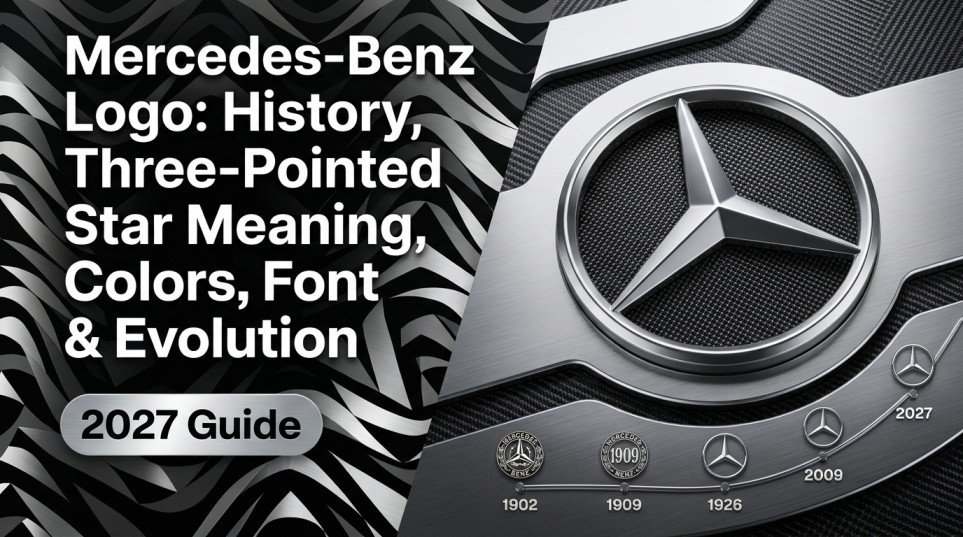
Quick Answer: The Mercedes-Benz logo is the iconic Three-Pointed Star enclosed inside a circular ring, symbolizing Gottlieb Daimler’s vision of universal motorization across land, sea, and air. Originating from a 1909 star emblem drawn by Daimler’s sons Paul and Adolf—and unified with Karl Benz’s laurel wreath in 1926 when Daimler-Motoren-Gesellschaft merged with Benz & Cie.—the mark uses Metallic Silver (#A4AAAE), Obsidian Black (#000000), and Pure White (#FFFFFF) alongside classic serif typography (Corporate A) to project timeless luxury and engineering precision.
Few automotive emblems carry over a century of uninterrupted prestige like the Mercedes-Benz Three-Pointed Star. While modern electric automakers lean on digital minimalism, Mercedes-Benz turned a simple geometric star from a family postcard into a universal shorthand for German engineering and executive luxury.
At-a-Glance: Mercedes-Benz Logo Fast Facts
| Brand Identity Element | Official Specification |
|---|---|
| Logo Elements | Three-pointed star inside a circular ring + “Mercedes-Benz” wordmark |
| Originators (1909 & 1926) | Paul & Adolf Daimler (three-pointed star) + Karl Benz (laurel wreath) |
| Core Meaning | Dominance of motorized transport across land, sea, and air |
| Primary Hex Color Codes | Metallic Silver (#A4AAAE), Obsidian Black (#000000), Pure White (#FFFFFF) |
| Primary Brand Font | Corporate A (classic serif) & Corporate S (clean sans-serif UI) |
Who Designed the Mercedes-Benz Logo and What Does the Star Mean?
In 1872, engineering pioneer Gottlieb Daimler sent a postcard to his wife marking their family home in Deutz, Germany, with a three-pointed star—writing that this star would one day shine over his own factory and symbolize prosperity.
After Daimler’s death, his sons Paul and Adolf Daimler recalled that postcard in 1909 while searching for a trademark for Daimler-Motoren-Gesellschaft (DMG)—the company behind the Mercedes brand (named after Mercédès Jellinek, daughter of entrepreneur Emil Jellinek). They registered both a three-pointed and a four-pointed star, selecting the three-pointed star to represent Gottlieb Daimler’s ambition to power engines across land, sea, and air.
Mercedes-Benz Logo Evolution: From 1902 to 2027
- 1902 (The Original “Mercedes” Oval): Featured the word “Mercedes” inside a horizontal oval before any star existed.
- 1909 (The Standalone Three-Pointed Star): DMG registered the gold and blue three-pointed star without an outer circle.
- 1916 (Adding the Outer Ring & Four Mini Stars): Enclosed the star inside a circle bordered by four smaller stars and the word “Mercedes.”
- 1926 (The Historic Daimler-Benz Merger): When DMG merged with Karl Benz’s company (Benz & Cie., creator of the world’s first gasoline automobile in 1886), designers combined Daimler’s three-pointed star with Benz’s laurel wreath—creating the unified Mercedes-Benz emblem.
- 1933–1989 (The Clean Ringed Star): Stripped away the intricate laurel wreath leaves, leaving the minimalist three-pointed star inside a sleek circular ring.
- 1989–Present (3D Chrome & Flat Digital Star): Introduced the iconic brushed-silver 3D star for vehicle grilles alongside a crisp, flat 2D vector star for digital interfaces, electric EQ vehicles, and mobile apps—mirroring the flat-design evolution seen in our Tesla Logo Guide and Ford Logo Guide.
Official Mercedes-Benz Logo Colors & Hex Codes
Mercedes-Benz anchors its luxury positioning in monochrome restraint and metallic precision:
- Mercedes Metallic Silver: Hex
#A4AAAE| RGB(164, 170, 174)— Represents precision engineering, silver-arrow racing heritage, and modern luxury hardware. - Obsidian Black: Hex
#000000| RGB(0, 0, 0)— Deep executive black used across primary corporate headers, luxury print campaigns, and dark-mode UI. - Pure White: Hex
#FFFFFF| RGB(255, 255, 255)— Clean negative-space backdrop for digital showrooms and high-contrast emblems.
What Font Does Mercedes-Benz Use?
Unlike tech companies that rely solely on geometric sans-serifs, Mercedes-Benz preserves its heritage elegance through Corporate A—a refined, high-contrast serif typeface designed by Kurt Weidemann in 1990—paired with Corporate S (sans-serif) for in-car MBUX touchscreens and technical specifications.
3 Branding Lessons Founders Can Steal From the Mercedes-Benz Logo
- Let Geometric Symmetry Anchor Trust: A three-pointed star inside a circle achieves instant visual balance from every angle—making it look equally authoritative on a steering wheel, a Formula 1 nose cone, or a 24-pixel app icon. You can test balanced geometric marks and vector symmetry using the tools in our Recraft V4.1 vs. Ideogram 3.0 vs. Midjourney V8.2 comparison.
- Use Monochrome & Metallic Palettes for Premium Positioning: Just as the Adidas Logo and Apple Logo rely on black, white, and silver rather than loud primary colors, Mercedes-Benz proves that color restraint signals luxury and confidence—a palette rule covered in our Best AI Brand Kit Generators for Startups in 2027 guide.
- Unify Mergers Through Shared Visual Symbols: When Daimler and Benz merged in 1926, blending one element from each heritage mark (star + wreath) prevented either brand from feeling erased—a clean brand-architecture principle you can organize with hubs reviewed in our Canva Magic Studio vs. Looka vs. Kittl breakdown.
Frequently Asked Questions (FAQ)
What do the three points on the Mercedes-Benz star stand for?
The three points symbolize Gottlieb Daimler’s goal of universal motorization across land, sea, and air—reflecting Daimler engines powering cars, ships, and aircraft.
Why is the Mercedes-Benz logo silver?
Mercedes-Benz uses silver (#A4AAAE) to evoke precision German engineering, luxury craftsmanship, and the brand’s legendary “Silver Arrows” Grand Prix racing cars of the 1930s.
When did Daimler and Benz combine their logos?
The two companies merged in 1926, uniting Daimler’s three-pointed star with Karl Benz’s circular laurel wreath under the Mercedes-Benz name.
What font does Mercedes-Benz use for its wordmark?
Mercedes-Benz uses Corporate A, a custom classic serif font designed by German typographer Kurt Weidemann.





Be First to Comment