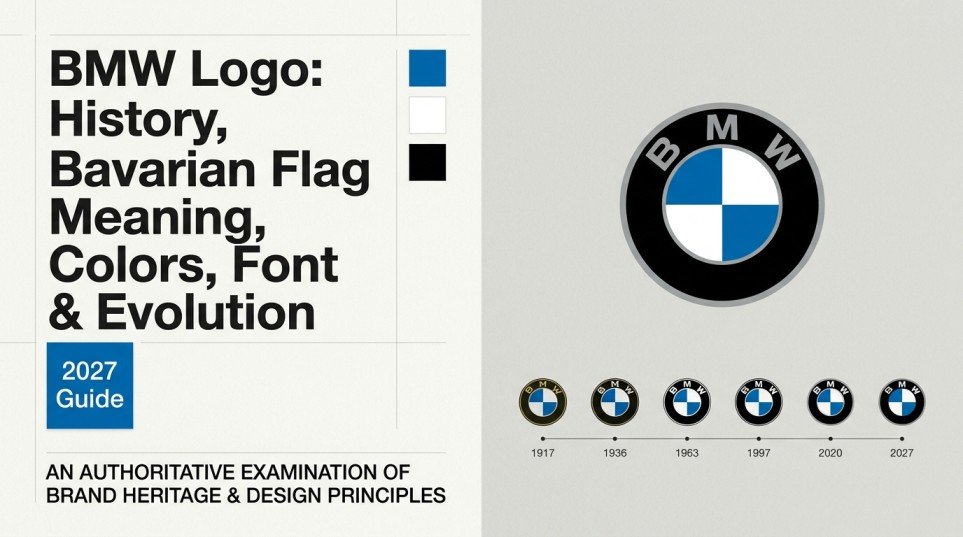
Quick Answer: The BMW logo is the iconic blue-and-white checkered BMW Roundel enclosed inside a black circular ring bearing the letters “BMW” (Bayerische Motoren Werke). Originally registered in October 1917 by Franz Josef Popp, the blue and white quadrants represent the official state colors of Bavaria, Germany (arranged in inverse order to comply with 1917 trademark laws prohibiting national/state symbols on commercial logos)—not a spinning airplane propeller, a popular myth sparked by a 1929 aircraft engine advertisement.
Few corporate emblems have inspired as much persistent folklore as the BMW Roundel. For nearly a century, drivers and aviation fans alike assumed the blue-and-white quadrants depicted a spinning propeller against a blue sky—when in reality, the design originated from regional pride and strict German trademark regulations.
At-a-Glance: BMW Logo Fast Facts
| Brand Identity Element | Official Specification |
|---|---|
| Logo Name | The BMW Roundel |
| Year Registered | October 5, 1917 (Rapp Motorenwerke transition to BMW) |
| Core Meaning | Colors of the Free State of Bavaria (inverted for trademark compliance) |
| Primary Hex Color Codes | BMW Blue (#0066B1), Pure White (#FFFFFF), Pitch Black (#000000), Metallic Silver (#6F6F6F) |
| Primary Brand Font | Custom bold geometric sans-serif (Helvetica Bold / BMW Type Next) |
Who Designed the BMW Logo and Where Did the “Propeller Myth” Come From?
BMW evolved out of Rapp Motorenwerke, an aircraft engine manufacturer in Munich, Germany. Rapp’s original logo featured a black circular ring displaying “RAPP MOTOR” around a silhouette of a knight chess piece.
When the company renamed itself Bayerische Motoren Werke (BMW) in July 1917, its leadership kept the outer black circular ring from Rapp’s logo—and replaced the chess piece inside with the blue and white checkered colors of Bavaria. Because German trademark law at the time forbade using official state coats of arms or flags directly in commercial trademarks, BMW arranged the blue and white quadrants in reverse order (starting with blue in the top-left quadrant instead of white).
The famous spinning airplane propeller myth didn’t appear until 1929—twelve years later—when a BMW print advertisement superimposed the BMW Roundel onto a rotating aircraft propeller to promote Pratt & Whitney airplane engines built under license by BMW. The visual stuck so well that BMW itself leaned into the story for decades before officially clarifying its Bavarian heritage.
BMW Logo Evolution: From 1917 to 2027
- 1917 (The Gold-Trimmed Bavarian Roundel): Featured gold borders and gold serif-tinged “BMW” lettering around a deep blue and white center circle.
- 1933–1953 (Bolder Ring & Cleaner Lettering): Thickened the black outer ring and standardized the geometric sans-serif “BMW” letters.
- 1963–1997 (Flat Bright Blue & White): Switched to vibrant sky-blue (
#0066B1) and crisp white borders, creating the classic flat emblem seen on E30 and E36 performance sedans. - 1997–2020 (3D Beveled Chrome): Added metallic 3D shading and drop shadows to mimic physical hood badges.
- 2020–Present (The Transparent Flat Digital Roundel): Unveiled alongside the Concept i4, BMW removed the solid black outer ring on digital and marketing applications—making the outer ring transparent so the background color shines through, joining the flat, digital-first wave seen in our Mercedes-Benz Logo Guide and Tesla Logo Guide.
Official BMW Logo Colors & Hex Codes
BMW’s visual system balances sporty Bavarian blue with clean industrial monochrome:
- BMW Signature Blue: Hex
#0066B1| RGB(0, 102, 177)— Vibrant royal-sky blue representing Bavaria and dynamic driving performance. - BMW M-Series Tri-Color Accents: Light Blue (
#00A0E9), Dark Violet-Blue (#1D2088), and Motorsport Red (#E60012) — Used exclusively on high-performance BMW M models. - Obsidian Black: Hex
#000000| RGB(0, 0, 0)— Used on physical vehicle roundels and high-contrast print headers. - Pure White: Hex
#FFFFFF| RGB(255, 255, 255)— Forms the opposing Bavarian quadrants and digital UI canvas.
What Font Does BMW Use?
The bold uppercase “BMW” letters inside the roundel are set in a custom-kerned geometric sans-serif closely aligned with Helvetica Bold. Across vehicle infotainment screens, websites, and global campaigns, BMW uses its proprietary BMW Type Next typeface.
3 Branding Lessons Founders Can Steal From the BMW Logo
- Respect Trademark Constraints Early—They Can Spark Iconic Design: BMW inverted the Bavarian flag colors purely to satisfy 1917 trademark rules, inadvertently creating an unmistakable four-quadrant symbol. When launching a startup, always verify trademark uniqueness before falling in love with a mark—using workflows from our Best AI Brand Kit Generators for Startups in 2027 guide.
- Keep Your Core Geometry Untouched for Over a Century: Just like the Ford Logo and Adidas Logo, BMW never changed its fundamental circle-and-quadrant layout—only updating surface textures (gold, flat, 3D, transparent) to fit each era. You can test flat vs. dimensional variations of your own logo using the vector tools in our Recraft V4.1 vs. Ideogram 3.0 vs. Midjourney V8.2 comparison.
- Design Transparent Marks That Adapt to Any Surface: BMW’s 2020 transparent outer ring allows the logo to sit cleanly over photography, dark-mode apps, and physical car paint without a clunky black border—a smart modularity lesson easy to apply in hubs reviewed in our Canva Magic Studio vs. Looka vs. Kittl breakdown.
Frequently Asked Questions (FAQ)
Does the BMW logo represent an airplane propeller?
No. Although BMW started by building aircraft engines, the blue and white quadrants in the BMW logo actually represent the official colors of the German state of Bavaria. The propeller story began as a 1929 marketing advertisement.
Why are the blue and white colors in the BMW logo reversed from the Bavarian flag?
In 1917, German trademark laws prohibited businesses from using official state flags or coats of arms in commercial trademarks, so BMW reversed the order of the blue and white quadrants to comply with the law.
What is the official hex code for BMW blue?
The official BMW brand blue hex code is #0066B1 (RGB: 0, 102, 177), paired with Pure White (#FFFFFF) and Obsidian Black (#000000).
Why did BMW make its logo transparent in 2020?
BMW introduced a transparent outer ring for digital communications in 2020 to create a cleaner, lighter visual presence across mobile apps, websites, and electric vehicle displays—while keeping the traditional black-ringed badge on physical vehicles.





Be First to Comment