By: Sujan Pariyar, Senior Editor
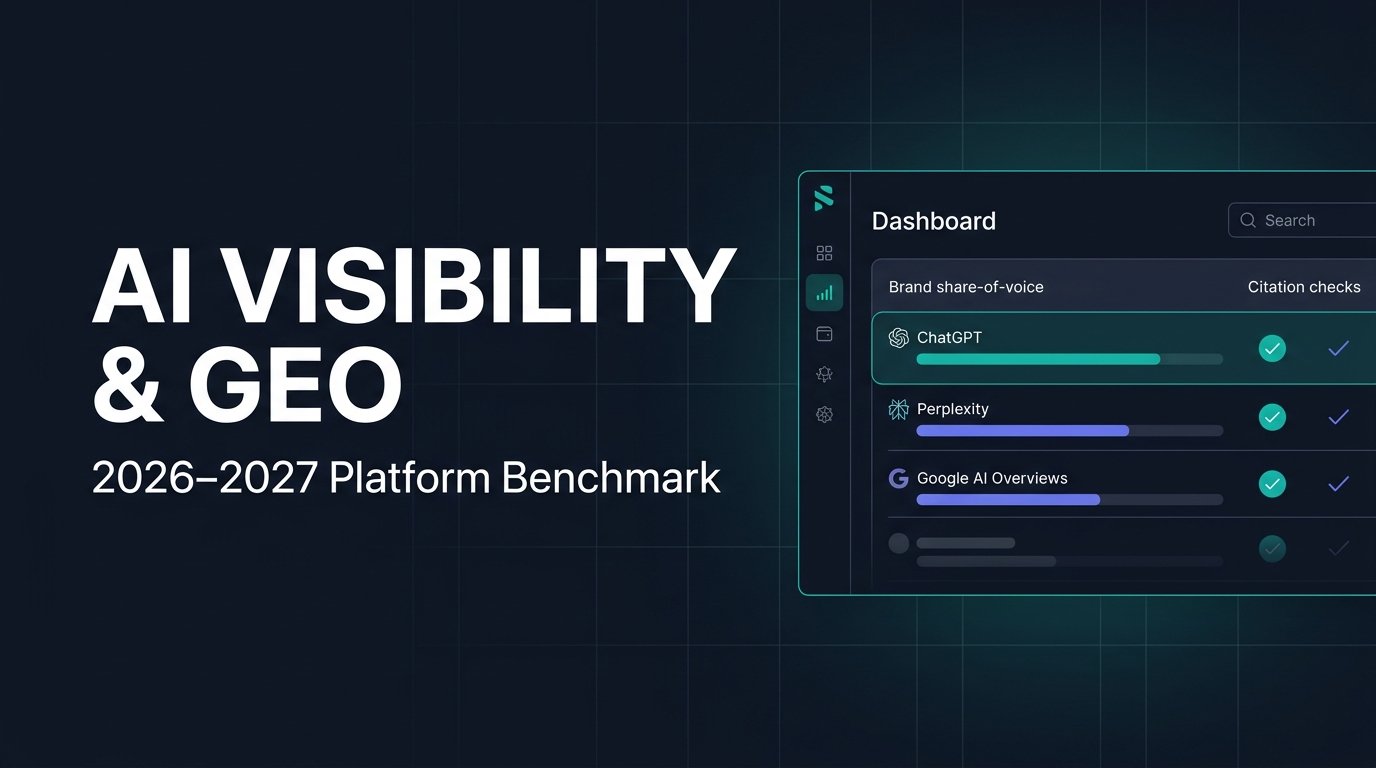
Traditional search rankings no longer tell the full story of brand discovery. As buyers shift from clicking ten blue links to asking ChatGPT, Perplexity, Gemini, and Google AI Overviews for software recommendations, marketing teams face a critical blind spot: knowing whether AI engines actually recommend their brand—or quietly hand the sale to a competitor.
Over the past year, a new category of software known as Generative Engine Optimization (GEO) and AI visibility tracking has emerged to solve this exact problem. Instead of tracking static keyword positions, these platforms run thousands of synthetic buyer prompts across major large language models (LLMs) to measure brand share of voice, sentiment, and source citations.
To help founders and growth teams pick the right stack for 2027, we evaluated the leading AI visibility platforms based on engine coverage, citation accuracy, prompt volume, and transparent pricing.
Quick Comparison: Top AI Visibility & GEO Platforms (2026–2027)
| Tool Name | Best For | AI Engines Tracked | Starting Price | Standout Feature |
|---|---|---|---|---|
| Profound | Enterprise brands & Fortune 500 teams | ChatGPT, Perplexity, Google AI Overviews, Copilot, Gemini, Claude | ~$499/mo (Enterprise custom) | AI crawler log analysis & deep prompt volume data |
| Peec AI | Fast-growing B2B SaaS & marketing teams | ChatGPT, Perplexity, Google AI Overviews, Gemini, Claude | ~$99/mo (€89/mo) | Clean multi-country prompt tracking & competitor share-of-voice |
| Otterly.AI | Budget-conscious startups & small agencies | ChatGPT, Perplexity, Google AI Overviews, Copilot | ~$29/mo | Automated link citation audits & brand sentiment tracking |
| AthenaHQ | Technical SEO & content optimization teams | ChatGPT, Perplexity, Google AI Overviews, Gemini, Claude | ~$295/mo | Actionable GEO content briefs & citation gap alerts |
| Scrunch AI | Brand protection & hallucination monitoring | ChatGPT, Perplexity, Google AI Overviews, Claude, Meta AI | ~$300/mo | Misinformation detection & AI agent feed optimization |
| Ahrefs Brand Radar | Existing Ahrefs subscribers wanting quick checks | Google AI Overviews, ChatGPT, Perplexity | Included / Add-on ($199+/mo) | Massive existing search index & instant brand mention alerts |
| Semrush AI Toolkit | All-in-one digital marketing suites | ChatGPT, Google AI Overviews, Perplexity, Gemini | ~$99/mo add-on | Seamless integration with traditional SEO keyword workflows |
1. Profound — Best for Enterprise Brands and Deep Crawler Analytics
Profound has quickly established itself as the enterprise standard in the GEO space. While lightweight trackers simply scrape web interfaces to see what an LLM says, Profound combines prompt monitoring with server-side AI crawler analytics, showing technical teams exactly how often OpenAI, Anthropic, and Google bots index their site.
- What stands out: Its Conversation Explorer surfaces real user prompt trends rather than forcing teams to guess what buyers are asking. It also tracks exact citation URLs, showing which third-party listicles and review sites feed AI answers in your category.
- Limitations: Enterprise pricing puts it out of reach for early-stage startups, and the platform requires a dedicated SEO or growth lead to extract full value from its technical logs.
- Pricing: Starts around $499/month for growth tiers, scaling into custom enterprise contracts.
2. Peec AI — Best Overall for B2B SaaS Growth Teams
Peec AI strikes the strongest balance between clean user interface design, multi-model accuracy, and accessible mid-market pricing. Built specifically for SaaS marketing teams, it tracks how your brand stacks up against up to ten competitors across commercial buying prompts.
- What stands out: Peec excels at regional and multi-language tracking, making it easy to see how ChatGPT or Google AI Overviews answer buyer queries differently in the US, UK, and European markets. Its source-domain breakdown immediately highlights which external publishers you need to get featured on to boost AI visibility.
- Limitations: Lacks some of the deep server-log crawler diagnostics found in enterprise suites like Profound.
- Pricing: Starts around $99/month (€89/month) for core prompt tracking, with higher tiers for agencies.
3. Otterly.AI — Best Budget Option for Startups and Solo Marketers
If you want to start monitoring AI search visibility without committing to a $300+ monthly contract, Otterly.AI is the most accessible entry point on the market. It automates daily prompt runs across ChatGPT, Perplexity, and Google AI Overviews, turning complex LLM outputs into a clean Brand Visibility Index.
- What stands out: Otterly’s link-citation report clearly separates brand mentions (when an AI names your company) from clickable citations (when an AI links directly to your domain). It also includes built-in sentiment analysis to flag negative framing.
- Limitations: Prompt allowances on the starter plan fill up quickly if you track multiple product lines.
- Pricing: Starts at $29/month for the Lite plan, scaling up to $189/month for standard marketing teams.
4. AthenaHQ — Best for Actionable Content and Citation Optimization
Most visibility trackers stop at reporting bad news—telling you that a competitor beat you in ChatGPT without explaining how to fix it. AthenaHQ focuses heavily on closing the execution gap, translating visibility losses into concrete content and digital PR recommendations.
- What stands out: Its citation-gap engine identifies the exact third-party articles, Reddit threads, and comparison guides that LLMs cite when recommending your competitors. It then generates structured content briefs designed to earn placement in those same model responses.
- Limitations: Higher starting price than basic trackers, and fewer integrations with legacy rank-tracking tools.
- Pricing: Starts around $295/month.
5. Scrunch AI — Best for Brand Reputation and Hallucination Control
When AI models cite outdated pricing, discontinued features, or flat-out false claims about your product, enterprise deals stall before a prospect ever visits your website. Scrunch AI approaches visibility from a brand-governance and accuracy perspective.
- What stands out: Scrunch continuously audits AI responses for factual inaccuracies—such as models claiming your tool lacks an integration you shipped six months ago—and pinpoints the outdated source pages feeding the model bad data.
- Limitations: Less focused on traditional keyword-to-prompt discovery compared to SEO-native tools.
- Pricing: Starts around $300/month.
6. Ahrefs Brand Radar — Best for Quick Checks Inside an Existing SEO Workflow
For teams already paying for an Ahrefs subscription, Brand Radar offers a convenient way to monitor AI mentions alongside traditional backlinks and organic search traffic.
- What stands out: Zero learning curve for existing Ahrefs users, backed by one of the largest web-crawling infrastructures in the industry.
- Limitations: As we documented in our Complete 2026 AI Timeline, independent testing surfaced notable accuracy gaps in Brand Radar’s citation tracking compared to dedicated GEO tools, occasionally undercounting live mentions. Treat it as a directional pulse check rather than a standalone audit tool.
- Pricing: Available within Ahrefs plans, with expanded AI tracking add-ons starting around $199/month.
7. Semrush AI Visibility Toolkit — Best All-in-One Marketing Suite Add-On
Semrush integrated AI search tracking directly into its broader marketing platform, allowing digital agencies and in-house teams to compare traditional Google SERP share against AI search share under one login.
- What stands out: Smooth workflow integration. You can take a high-converting organic keyword list and immediately test how those topics trigger brand mentions inside ChatGPT and Google AI Overviews.
- Limitations: Interface can feel crowded if you only want a dedicated, lightweight AI tracker, and add-on costs scale rapidly across multiple domains.
- Pricing: Starts around $99/month as an add-on to existing Semrush subscriptions.
Honorable Mentions: Emerging GEO Platforms to Watch in 2027
Beyond the seven core platforms above, several specialized challenger tools are gaining traction among technical marketers and agencies:
- Rankscale: A fast-moving GEO audit tool gaining popularity for granular citation scoring and competitor benchmarking across European and North American markets.
- Knowatoa: An early pioneer in tracking how commercial buyer intent translates across different LLM versions, particularly useful for e-commerce and B2B SaaS catalogs.
- Goodie AI: A rising platform combining visibility tracking with automated content optimization workflows for consumer brands.
(Editorial Note: We update this benchmark monthly as AI search engines and model architectures evolve. Building an AI visibility or GEO platform and want your 2027 pricing, engine coverage, or product updates tested for our next revision? Send product specs and demo access to our editorial desk via our Contact page.)
How to Choose the Right AI Visibility Tool for 2027
Before signing an annual software contract, match your selection to your team’s immediate bottleneck—a discipline we emphasized in our Gartner and McKinsey 2027 AI Spending ROI Report to avoid wasted SaaS spend:
- If you are validating GEO for the first time: Start with Otterly.AI ($29/mo) or Peec AI ($99/mo) to establish a baseline share-of-voice score across your top 25 buyer prompts.
- If you already know you are losing to competitors in ChatGPT: Choose AthenaHQ to identify the exact third-party comparison sites and publications you need to target for digital PR and editorial placement.
- If you manage a high-traffic enterprise domain: Invest in Profound to correlate server-side AI crawler behavior with real citation gains.
Frequently Asked Questions
What is an AI visibility tool?
An AI visibility tool (also called a GEO or Generative Engine Optimization platform) tracks how often your brand, products, and website URLs are mentioned or cited in answers generated by AI search engines like ChatGPT, Perplexity, Gemini, and Google AI Overviews.
How is GEO different from traditional SEO?
Traditional SEO focuses on ranking web pages in search engine results for specific keywords. GEO focuses on influencing the underlying training data, real-time web search results, and third-party citations that large language models use to synthesize direct recommendations.
Which AI search engines matter most for B2B software brands in 2027?
For B2B software discovery, ChatGPT (with live web search), Google AI Overviews, and Perplexity drive the highest volume of commercial research queries, followed by Claude and Microsoft Copilot for enterprise buyers.

Sujan Pariyar is an international writer. He frequently writes about tech, AI, business, and travel on Silicon Valley Times, NYWeekly, Washington Magazine, Huffpost, Thrive Global and more.




Be First to Comment